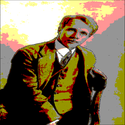
Robert Frost
Robert Frost: A Literary Icon
Full Name and Common Aliases
Robert Lee Frost, commonly known simply as Robert Frost, is a name that resonates deeply within the realm of American poetry. Often referred to as the quintessential New England poet, Frost's work captures the essence of rural life and the complexities of human emotion.
Birth and Death Dates
Robert Frost was born on March 26, 1874, in San Francisco, California, and passed away on January 29, 1963, in Boston, Massachusetts. His life spanned nearly nine decades, during which he became one of the most celebrated poets in American history.
Nationality and Profession(s)
Robert Frost was an American poet, renowned for his depictions of rural New England life and his command of American colloquial speech. His profession as a poet and educator allowed him to influence generations of readers and writers alike.
Early Life and Background
Robert Frost's early life was marked by both promise and hardship. Born to William Prescott Frost Jr., a journalist, and Isabelle Moodie, a Scottish immigrant, Frost's family moved to Lawrence, Massachusetts, following his father's death in 1885. This relocation to New England would profoundly influence his poetic voice. Frost attended Dartmouth College briefly before returning home to support his family. He later enrolled at Harvard University but left before completing his degree. Despite these academic interruptions, Frost's passion for poetry never waned, and he continued to write while working various jobs to support his family.
Major Accomplishments
Robert Frost's career is distinguished by numerous accolades and achievements. He won the Pulitzer Prize for Poetry four times, a testament to his profound impact on American literature. These awards were for his collections "New Hampshire" (1924), "Collected Poems" (1931), "A Further Range" (1937), and "A Witness Tree" (1943). Frost also received the Congressional Gold Medal in 1960 for his contributions to American culture and was named Poet Laureate of Vermont in 1961.
Notable Works or Actions
Frost's body of work is vast and varied, but several poems stand out for their enduring popularity and critical acclaim. "The Road Not Taken," with its exploration of choice and consequence, remains one of his most quoted and analyzed poems. "Stopping by Woods on a Snowy Evening" is celebrated for its serene imagery and contemplative tone. Other notable works include "Mending Wall," "Birches," and "Fire and Ice," each reflecting Frost's mastery of language and his ability to convey complex themes with simplicity and grace.
Impact and Legacy
Robert Frost's impact on literature and culture is immeasurable. His ability to capture the nuances of rural life and human emotion in a way that was both accessible and profound earned him a place in the pantheon of great American poets. Frost's work is characterized by its use of traditional verse forms and conversational language, which made poetry more approachable to the general public. His influence extends beyond poetry, as he also played a significant role in education, teaching at several prestigious institutions, including Amherst College and Harvard University.
Why They Are Widely Quoted or Remembered
Robert Frost is widely quoted and remembered for his ability to distill complex human experiences into simple yet profound language. His poems often explore themes of nature, individuality, and the passage of time, resonating with readers across generations. Frost's work is frequently cited for its philosophical depth and emotional resonance, making it a staple in both academic and popular discourse. His famous lines, such as "Two roads diverged in a wood, and I— / I took the one less traveled by," have become part of the cultural lexicon, symbolizing the universal human experience of choice and reflection.
In conclusion, Robert Frost's legacy as a poet and cultural icon endures because of his unique ability to capture the essence of the human condition. His work continues to inspire and challenge readers, ensuring that his voice remains a vital part of the literary landscape.
Quotes by Robert Frost
Robert Frost's insights on:
The woods are lovely, dark and deep. / But I have promises to keep, / And miles to go before I sleep.
The brain is a wonderful organ it starts working the moment you get up in the morning and does not stop until you get into the office.
Two roads diverged in a wood, and I— / I took the one less traveled by, / And that has made all the difference.
Yes, of course, this age is materialistic, but the only way to counteract it is to create spiritual things. Don't worry about materialism too much. Create and stir other people to create.
It looked as if a night of dark intent was coming, and not only a night, an age. Someone had better be prepared for rage.
The world is full of willing people, some willing to work, the rest willing to let them.
Two roads diverged in a wood, and I, / I took the one less traveled by, / And that has made all the difference.
O hushed October morning mild,Begin the hours of this day slow.Make the day seem to us less brief.